

Why Traditional Queue Systems Fail in Banking
Discover why traditional queue systems fail in banking and financial services and how modern digital queue management systems like MyTurn improve efficiency and customer experience.

MyTurn Product Team
Customer Experience Platform Experts
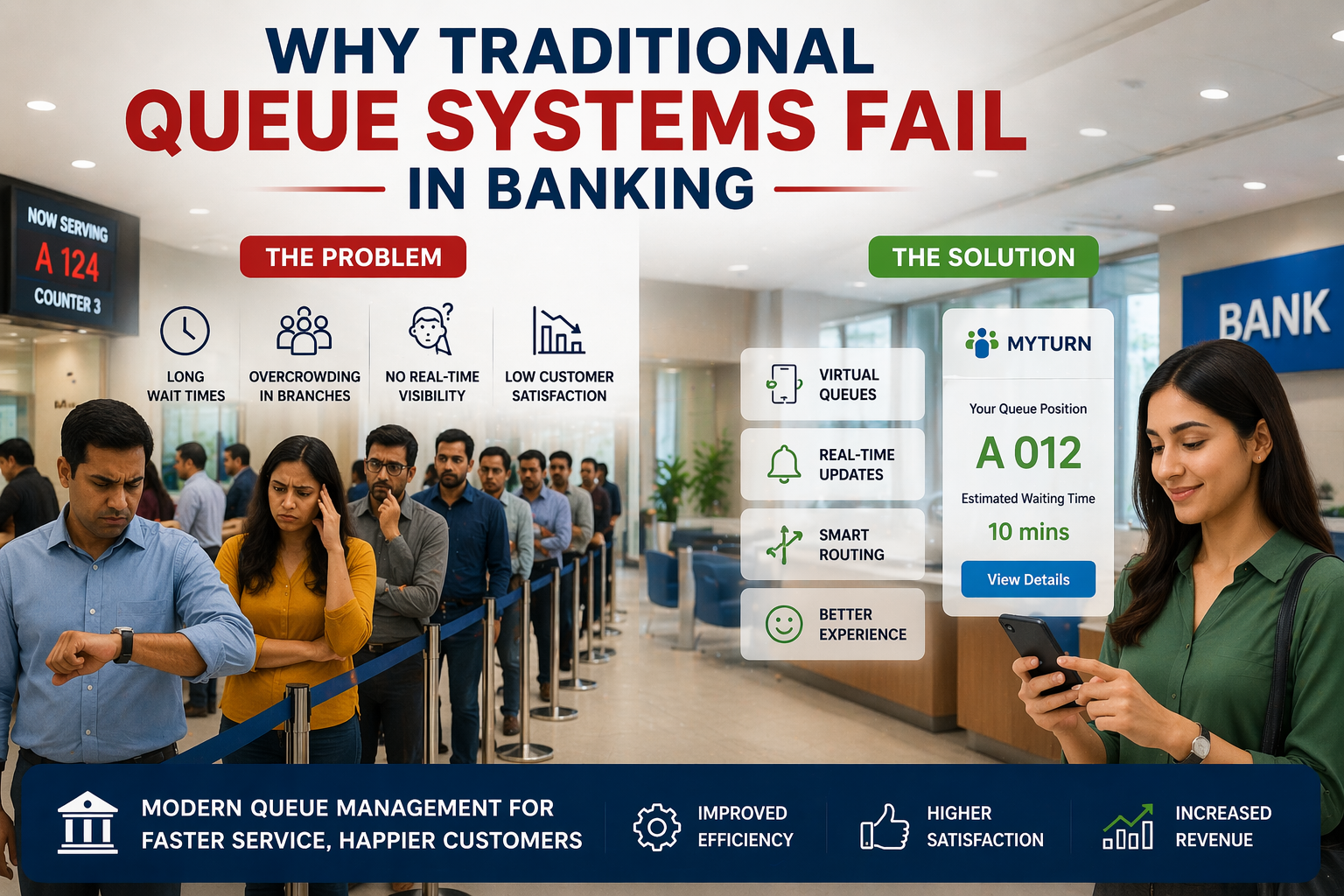
In today’s fast-evolving banking and financial services industry, customer expectations are higher than ever. While institutions have invested heavily in digital transformation, one major problem still remains unsolved in many branches — inefficient queue management.
Long waiting lines, poor service flow, and frustrated customers continue to impact business performance. Traditional queue systems are no longer capable of handling modern customer demands.
This article explores why outdated queue systems fail and how modern solutions like MyTurn are transforming the future of banking and financial services.
The Reality of Traditional Queue Systems
Traditional queue systems are based on simple principles: customers arrive, take a ticket, and wait for their turn. While this system may have worked in the past, it is no longer suitable for today’s dynamic service environments.
Modern banking requires speed, personalization, and efficiency — something traditional systems fail to deliver.

Top Problems with Traditional Queue Systems
1. Lack of Transparency
Customers have no clear idea of their waiting time. This uncertainty creates frustration, anxiety, and a poor overall service experience.
2. Inefficient Resource Allocation
Staff are often underutilized or overwhelmed because traditional systems do not provide real-time visibility into customer flow or service demand.
3. No Customer Prioritization
High-value customers, urgent service cases, and advisory appointments are often treated the same as general walk-ins, reducing service quality.
4. Physical Crowding
Branches become overcrowded, creating discomfort, longer visible queues, and a negative customer perception of the institution.
5. Increased Drop-Off Rate
Many customers leave before being served, resulting in lost business opportunities, missed revenue, and weaker customer loyalty.
Impact on Banking & Financial Institutions
These inefficiencies create serious operational and customer experience challenges for banks and financial service providers.
- Lower customer satisfaction
- Reduced operational efficiency
- Higher employee stress
- Negative brand image
- Loss of potential revenue
As customer expectations continue to rise, relying on outdated systems becomes a major competitive disadvantage.
The Shift Toward Digital Queue Management
To overcome these challenges, banks and financial institutions are adopting digital queue management systems. These platforms replace physical lines with virtual queues, real-time notifications, and intelligent service workflows.
This shift helps institutions deliver faster, more organized, and more customer-centric service experiences.
What is a Digital Queue Management System?
A digital queue management system allows customers to join queues remotely, receive real-time updates, and get served efficiently based on their needs, service type, or priority level.
Instead of creating frustration in the branch, digital queueing gives customers more clarity, flexibility, and convenience.
Key Features of Modern Queue Systems
Virtual Queues
Customers can join from anywhere without physically standing in line, improving convenience and reducing crowding in branches.
Appointment Scheduling
Pre-booked visits reduce congestion, improve planning, and help institutions prepare the right staff for each service request.
Smart Routing
Customers are directed instantly to the right staff member or service desk, reducing delays and improving first-time resolution.
Real-Time Data
Managers receive live insights into wait times, service demand, and team performance, enabling better operational decisions.
AI Integration
Artificial intelligence helps predict demand, optimize workflows, and improve staffing efficiency automatically.
Benefits of Switching to MyTurn
Reduced Waiting Time
Customers spend less time waiting and more time receiving meaningful service, improving both efficiency and satisfaction.
Improved Customer Experience
Better transparency, better flow, and more predictable service create a smoother and more professional customer journey.
Higher Staff Productivity
Employees can focus on service delivery and advisory tasks instead of manually handling queues or managing branch crowding.
Increased Revenue
Serving more customers efficiently reduces abandonment rates and creates more opportunities for conversions and retention.
Better Operational Control
MyTurn gives institutions better visibility into performance, wait times, staffing efficiency, and overall service quality.
AI-Powered Queue Management
AI takes queue systems to the next level by predicting demand, optimizing staff allocation, and improving decision-making in real time.
Instead of reacting to service issues after they happen, financial institutions can proactively manage workloads and improve customer flow before bottlenecks appear.
Real-World Example
A financial institution implementing MyTurn reduced waiting time by over 40% and significantly improved customer satisfaction through digital queueing, smarter service allocation, and better visibility into branch operations.
Future of Queue Management
The future lies in intelligent, automated, and personalized systems that improve both customer and employee experiences across every service channel.
- AI-powered demand forecasting
- Smarter omnichannel experiences
- Personalized service journeys
- Real-time analytics and automation

Why MyTurn is the Right Choice
MyTurn offers a powerful, scalable, and AI-driven queue management solution designed for modern banking and finance. It helps institutions improve service flow, increase efficiency, and deliver a more seamless customer experience.
- Digital and virtual queue management
- Appointment booking and smart routing
- Real-time performance insights
- AI-powered service optimization
Conclusion
Traditional queue systems are outdated and inefficient. To stay competitive, banks and financial institutions must adopt modern digital solutions like MyTurn.
In a world where time defines customer satisfaction, upgrading your queue system is not just an option — it is a necessity.
Ready to optimize your workflow?
Contact our experts to see how Why Traditional Queue Systems Fail in Banking can be tailored to your specific business needs.
Talk to an Expert