
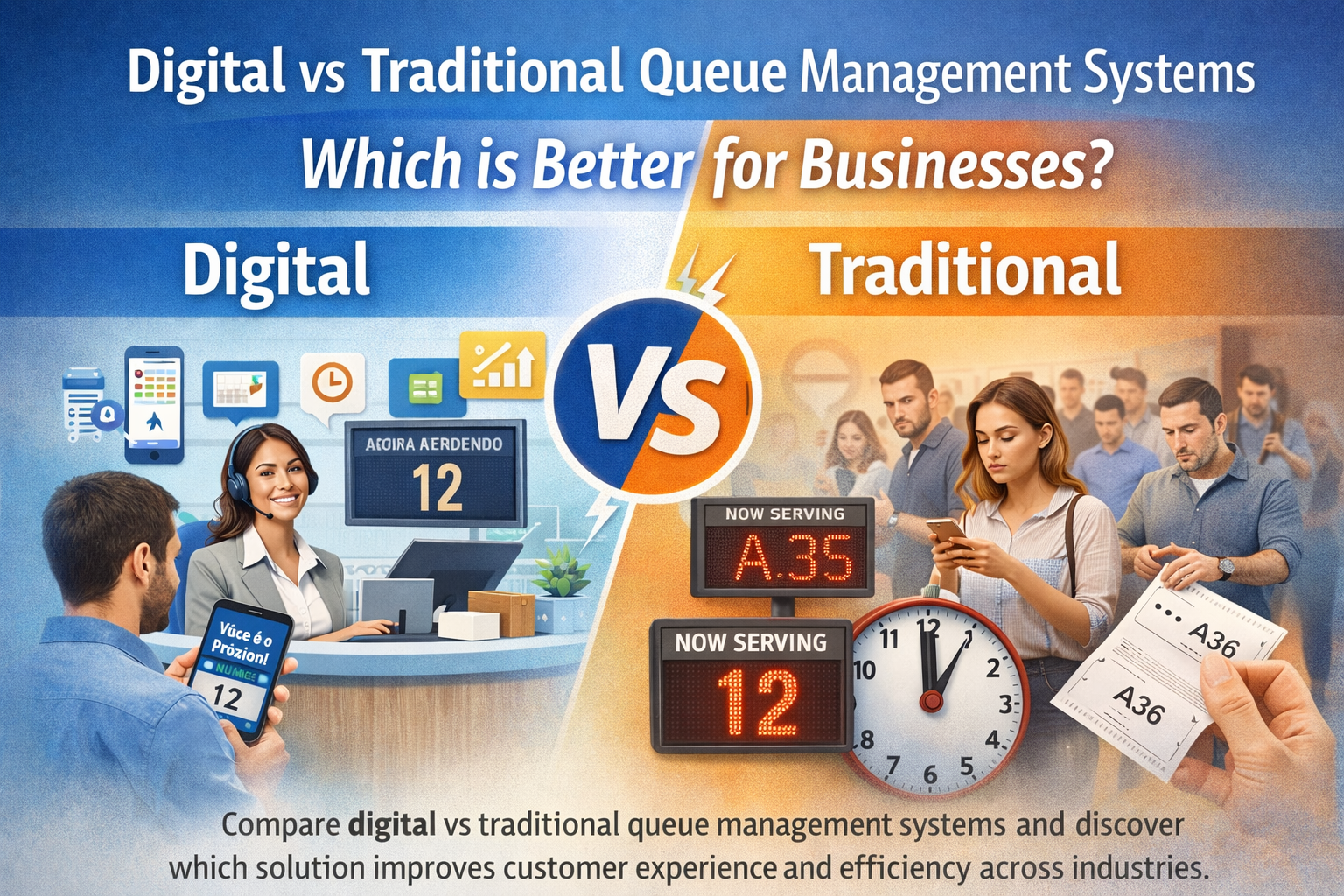
Digital vs Traditional Queue Management Systems | Which is Better for Businesses?
Compare digital vs traditional queue management systems and discover which solution improves customer experience and efficiency across industries.

MyTurn Product Team
Customer Experience Platform Experts
In today’s customer-driven economy, businesses across industries are constantly seeking ways to improve service efficiency and enhance customer experience.
Whether it is banking, healthcare, retail, telecom, or public administration, managing customer flow effectively is a critical factor in achieving operational success.
One of the most common challenges faced by organizations is handling queues efficiently. Long waiting times, overcrowded spaces, and inefficient processes can negatively impact both customer satisfaction and business performance.
Traditionally, businesses relied on manual or basic queue systems. However, with the rise of digital transformation, modern queue management systems like MyTurn offer advanced solutions that address these challenges more effectively.
Understanding Traditional Queue Management Systems
Traditional queue systems are commonly used in various industries where customers wait in physical lines or use token-based systems. These systems are simple and easy to implement but have significant limitations.
Customers typically wait in line without clear information about their position or waiting time. This creates uncertainty and frustration.
While these systems may work in low-demand environments, they struggle to handle high customer volumes efficiently.
Key Limitations of Traditional Queue Systems
1. Long Waiting Times
Traditional systems often result in long waiting times, especially during peak hours. Customers may spend a significant amount of time waiting for service.
This leads to frustration and dissatisfaction, negatively affecting the overall experience.
Reducing waiting time is essential for improving customer satisfaction.
2. Lack of Transparency
Customers have limited visibility into queue status and waiting time.
This lack of information creates uncertainty and stress.
Transparency is crucial for building trust.
3. Overcrowded Service Areas
Physical queues create congestion, making service areas crowded and uncomfortable.
Overcrowding reduces the quality of the customer experience.
It also affects staff efficiency.
4. Inefficient Operations
Manual processes slow down service delivery and increase the likelihood of errors.
Staff must manage queues in addition to their primary responsibilities.
This reduces productivity.
5. No Data Insights
Traditional systems do not provide data on customer flow or performance.
This makes it difficult to identify areas for improvement.
Data is essential for modern decision-making.
What is Digital Queue Management?
Digital queue management systems use technology to organize customer flow efficiently. They replace physical queues with virtual queues, appointment scheduling, and real-time notifications.
Customers can join queues remotely, track their position, and receive updates about their turn.
This creates a more efficient and customer-friendly system.
Key Features of Digital Queue Systems
Virtual Queues
Customers can join queues digitally without standing in line. This reduces congestion and improves comfort.
Appointment Scheduling
Customers can book appointments in advance. This helps manage demand effectively and reduces peak-time pressure.
Real-Time Notifications
Customers receive updates about their queue status. This improves transparency and reduces uncertainty.
Smart Routing
Customers are directed to the appropriate service point. This reduces delays and improves efficiency.
Data Analytics
Businesses can analyze customer flow and performance. This enables better decision-making and continuous efficiency improvements.
Digital vs Traditional Queue Systems: Detailed Comparison
Customer Experience
Traditional systems often create frustration due to long waiting times and lack of information. Digital systems provide a smoother and more transparent experience with real-time updates.
Operational Efficiency
Traditional systems rely on manual processes, which are slow and inefficient. Digital systems automate queue management, improving speed and accuracy.
Scalability
Traditional systems struggle to handle large customer volumes, while digital systems can scale easily to accommodate growing demand.
Cost Efficiency
Manual systems may seem cost-effective initially but lead to inefficiencies over time. Digital systems optimize operations and reduce long-term costs.
Decision-Making
Traditional systems lack data insights, while digital systems provide actionable data that helps businesses make better operational decisions.
Role of AI in Digital Queue Systems
Artificial intelligence enhances queue management by predicting demand and optimizing workflows.
- Predict peak hours
- Optimize staffing
- Improve service efficiency
AI makes queue systems smarter, faster, and more effective.
Future of Queue Management
The future of queue management lies in digital transformation and automation.
- AI-driven solutions
- Contactless services
- Omnichannel experiences
Businesses must adapt to remain competitive.
Why Choose MyTurn?
MyTurn offers a comprehensive digital queue management solution for businesses across industries.
- Easy integration
- Real-time insights
- Improved customer experience
It helps businesses optimize operations and achieve better results.
Conclusion
Traditional queue systems are no longer suitable for modern businesses. They create inefficiencies and poor customer experiences.
Digital queue management systems provide a smarter and more effective solution. By adopting MyTurn, businesses can reduce waiting times, improve efficiency, and enhance customer satisfaction.
Investing in digital solutions is essential for long-term success.
Ready to optimize your workflow?
Contact our experts to see how Digital vs Traditional Queue Management Systems | Which is Better for Businesses? can be tailored to your specific business needs.
Talk to an Expert