
Every year, airports worldwide handle billions of passengers — and every one of them has experienced the same thing: standing in a long, slow-moving line with no idea when it will end.
Whether it is the check-in counter at 6 a.m., a security lane backed up for 45 minutes, or an immigration hall that feels more like a crowd than a process, queuing is the single biggest source of passenger frustration in aviation. The operational cost is equally severe: airports that cannot manage passenger flow face missed connections, stressed staff, regulatory pressure, and reputational damage that influences airline partnerships and traveler loyalty.
Airport queue management systems (QMS) are the operational backbone that modern airports use to turn chaotic passenger movement into a structured, predictable, and measurable experience. This guide covers everything airport operations managers, terminal planners, and IT directors need to know — from what a QMS actually does, to the specific checkpoints it optimizes, to the data-driven ROI it delivers.
By the end, you will understand exactly what to look for in a system, what questions to ask vendors, and how leading airports are already reducing wait times by over 40% using digital queue management platforms like MyTurn.
Why Airports Need Digital Queue Management
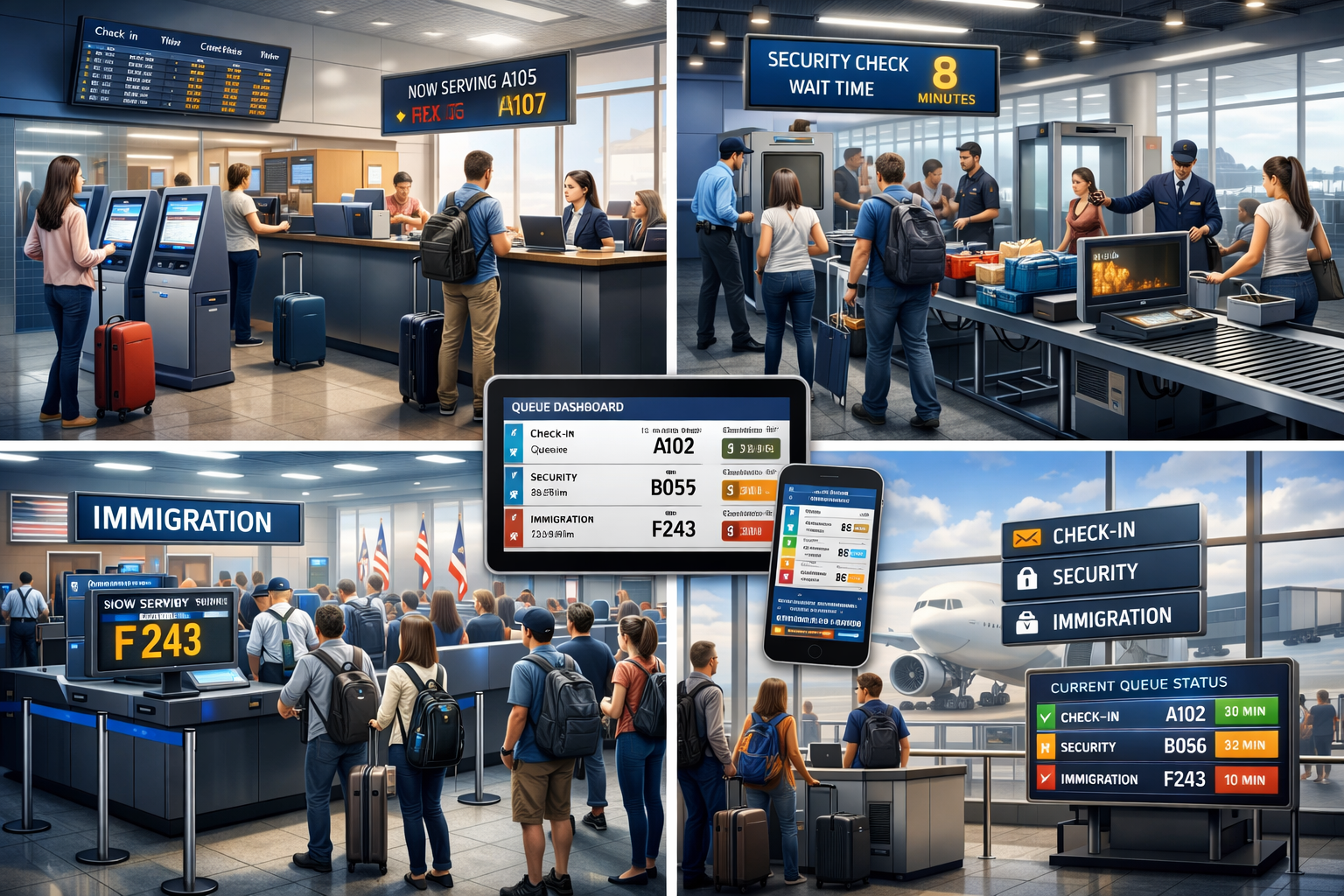
The scale of modern airport operations makes manual queue management effectively impossible. A major international hub may process 80,000 to 120,000 passengers per day across dozens of service points — check-in desks, self-service kiosks, security lanes, immigration booths, baggage claim, lounges, and gate boarding queues. Each checkpoint creates an opportunity for a bottleneck, and bottlenecks cascade: a 10-minute delay at security does not stay at security. It pushes passengers late to gates, delays boarding, and ultimately delays departures.
According to industry research by SITA (Société Internationale de Télécommunications Aéronautiques), 54% of passengers rank long queues as their top source of airport frustration — above flight delays, poor signage, and limited facilities. Airports with high wait-time scores consistently receive lower satisfaction ratings from independent surveys, which directly affects their ACI Airport Service Quality (ASQ) scores used by airlines when evaluating route opportunities.
A digital queue management system addresses this at its root. Rather than relying on physical barriers, paper ticket systems, or staff directing passengers by hand, a QMS uses real-time data, digital displays, mobile integration, and predictive analytics to distribute passenger load intelligently across all available service channels. The result is not just shorter queues — it is smarter queues: ones that adjust dynamically as conditions change.
MyTurn's airport QMS platform integrates with airline DCS (Departure Control Systems), biometric kiosks, and airport FIDS (Flight Information Display Systems) to create a unified operational view — reducing average wait times by up to 42% and raising passenger satisfaction scores significantly.
Check-In Queue Management: The First Impression That Sets the Tone
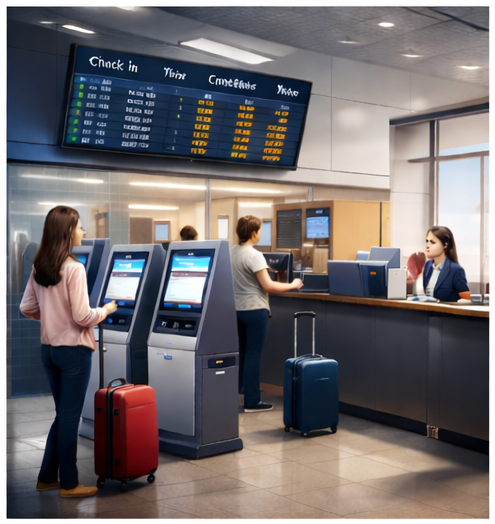
Check-in is where the airport experience begins — and where many airports lose the battle before the flight even boards. Traditional check-in management relies on static lane assignments, physical barriers, and supervisors manually redirecting passengers when queues grow uneven. The result is predictably inconsistent: some desks have queues snaking back 50 metres while adjacent desks sit idle.
A modern airport QMS transforms check-in through three key mechanisms:
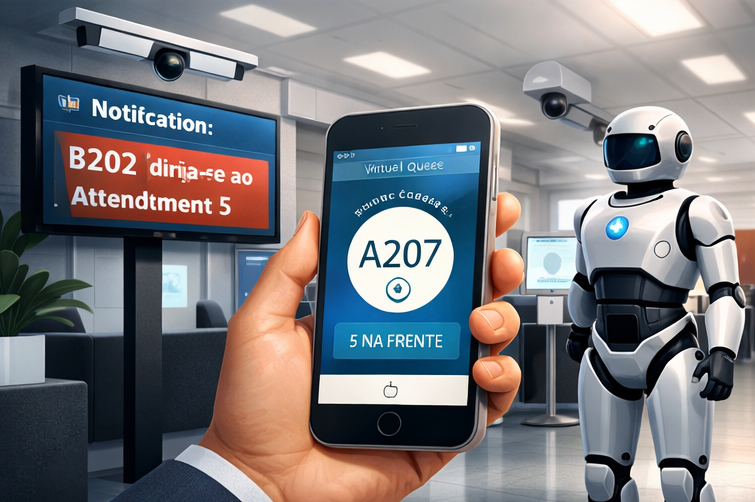
Virtual queue assignment: Passengers scan a QR code from their airline app or at an entrance kiosk and receive a virtual queue position. They are free to wait anywhere in the terminal — at a café, retail outlet, or seating area — and receive a push notification or SMS when their turn is approaching. This eliminates physical crowding at the check-in area and increases retail dwell time, a key revenue metric for airport commercial teams.
Dynamic counter allocation: The QMS monitors queue depth in real time across all check-in desks. When a queue exceeds a configurable threshold, the system automatically alerts supervisors or triggers signage updates directing passengers to underutilized desks. In airports using shared check-in infrastructure across multiple airlines, this becomes critical for efficient resource use.
Kiosk and agent integration: Modern check-in flows are hybrid — some passengers use self-service kiosks, others go to staffed desks for complex itineraries, excess baggage, or accessibility needs. A QMS treats all channels as a unified queue, routing passengers to the most appropriate option based on their profile and service complexity. Airports that reduce check-in wait times from an average of 18 minutes to under 10 minutes report measurable increases in pre-security retail spending.
Security Lane Optimization: Eliminating the Biggest Bottleneck
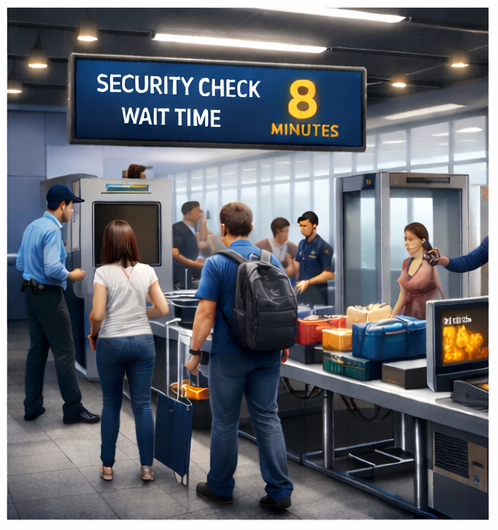
Security screening is consistently the most significant operational chokepoint in any airport. Unlike check-in — where demand is partly predictable based on flight schedules — security volume can spike sharply and unpredictably based on delayed flights, early connections, and group passengers arriving simultaneously. A queue that takes 8 minutes at 7:15 a.m. may take 34 minutes at 7:30 a.m. due to a single cluster of 200 arriving passengers.
Airport queue management systems address security bottlenecks through three primary capabilities:
Predictive lane staffing: By integrating with flight data, historical throughput records, and real-time passenger counts, a QMS can predict security volume up to 90 minutes in advance. Operations managers receive alerts when projected volume will exceed current lane capacity, allowing proactive staffing rather than reactive scrambling.
Intelligent lane assignment: Digital signage at security entry points displays real-time wait estimates per lane, directing passengers toward the shortest available queue. For airports with differentiated security lanes (standard, premium, crew, accessibility), the QMS ensures each lane receives appropriate volume without overflow.
Throughput measurement and SLA tracking: Every security interaction is logged — entry time, wait time, processing time, and exit time. Operations teams can track performance against service level agreements in real time and produce automated reports for regulatory compliance and process audits. A regional European airport implementing a QMS across its three security checkpoints reported a 31% reduction in average security wait time within 90 days — without adding any additional screening lanes or staff.
Immigration & Border Control: Managing Volume Without Compromising Security
Immigration processing presents a uniquely complex queue management challenge. Unlike check-in and security, immigration timelines are not within the airport's full control — border agency staffing, passport inspection protocols, and biometric verification requirements all affect throughput. Yet passengers experience immigration delays as an airport problem, not a government problem.
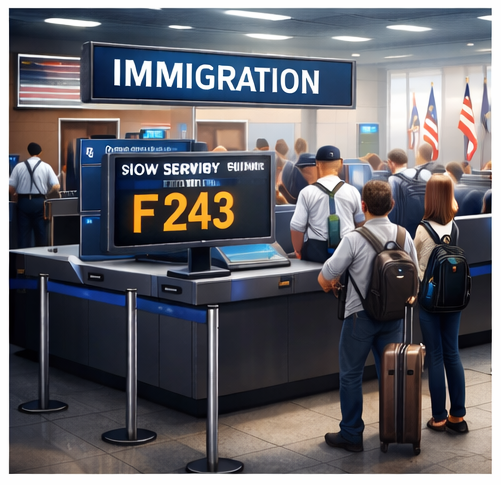
A QMS integrated with immigration infrastructure addresses this on several fronts. Dynamic booth routing maintains visibility into the status of each immigration booth — occupied, processing, available, offline — and routes arriving passengers to the next available officer, eliminating the frustration of watching one queue move three times faster than yours.
e-Gate integration routes biometric passport holders directly to automated border control e-Gates, reducing burden on staffed booths and dramatically accelerating throughput for the majority of passengers. Arrival wave management uses inbound flight data to pre-position immigration staff and open additional booths proactively before large arrival clusters hit the hall — turning reactive crisis management into structured operations.
For immigration authorities, the system also provides audit-ready data on processing volumes, average handling times per officer, and queue breach events — all valuable for workforce planning and regulatory reporting.
Real-Time Analytics and Operations Intelligence
One of the most underappreciated advantages of a modern airport QMS is not what it does in the moment, but what it enables over time. Every transaction — every ticket issued, every passenger routed, every wait time logged — generates structured data. Over weeks and months, this becomes an extraordinarily detailed operational intelligence asset.
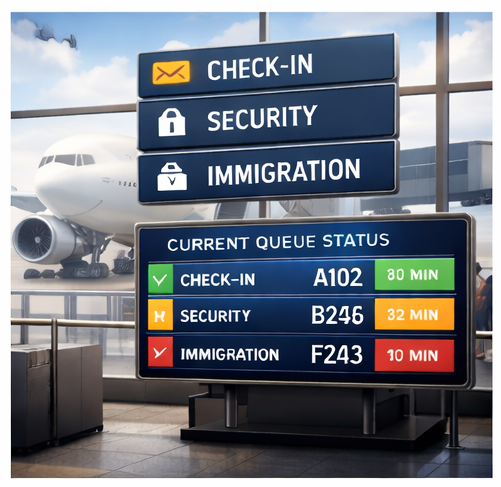
Live dashboards give operations centers a real-time visual overview of every service point in the terminal. Queue length, current wait time, average service duration, staff count, and SLA status are visible at a glance — on large monitoring screens and on mobile devices for floor supervisors. When a queue exceeds a defined threshold, automated alerts notify the relevant manager immediately.
Historical trend analysis answers operational questions that were previously unanswerable: Which security lane has the worst throughput on Monday mornings? Which check-in bank consistently runs short-staffed on bank holiday weekends? These answers drive real improvements. Demand forecasting combines historical data with live flight schedules to generate forward-looking load models — helping managers schedule staffing accurately for the next 24 to 48 hours, reducing both under-staffing and over-staffing.
By integrating QMS data with passenger satisfaction surveys, airports can directly quantify the relationship between wait time and NPS score — and use that evidence to justify capacity investment to airport boards and airline partners. Learn more about queue management analytics and business data insights.
Digital vs. Traditional Airport Queuing: Side-by-Side
The gap between traditional physical queue management and a modern digital QMS is not incremental — it is structural. Here is how the two approaches compare across the dimensions that matter most to airport operations teams:
| Feature | Traditional Queue System | Digital Queue Management System |
|---|---|---|
| Passenger wait experience | Physical line, standing, no time estimate | Virtual queue, seated, real-time updates via SMS or app |
| Queue monitoring | Visual observation by staff | Real-time dashboard with sensor and transaction data |
| Staffing decisions | Reactive — respond after bottleneck forms | Proactive — predictive alerts before bottleneck occurs |
| Data capture | None or manual tally sheets | Automatic — every transaction logged with timestamps |
| Multi-checkpoint coordination | Siloed per checkpoint | Unified system across check-in, security, immigration |
| Reporting & compliance | Manual, time-consuming, error-prone | Automated reports, audit trails, SLA tracking |
| Scalability | Requires physical infrastructure changes | Cloud-based, scalable without hardware overhaul |
| Retail revenue impact | Low — passengers stuck in physical queues | High — freed dwell time increases terminal spending |
Case Study: How a European Hub Airport Cut Immigration Wait Times by 38%
A major international hub airport in Western Europe handling over 40 million passengers annually faced a persistent problem: immigration wait times during peak arrival windows regularly exceeded 45 minutes, generating hundreds of formal complaints per month and damaging the airport's ACI ASQ score — a benchmark that directly influences airline confidence in the route.
The operations team implemented a cloud-based queue management system integrated with inbound flight data feeds, immigration booth sensors, and e-Gate availability tracking across two international arrival terminals covering 24 immigration booths and 18 e-Gates.
What changed operationally:
- Passenger routing screens at immigration hall entrances displayed real-time wait estimates for each processing channel, with visual guidance toward the fastest available option.
- The operations center received automated alerts when projected arrival volume would exceed booth capacity within 20 minutes — giving supervisors time to call additional officers before the queue formed.
- e-Gate routing for biometric passport holders reduced staffed-booth load by 22% during peak windows.
- Mobile dashboards allowed shift supervisors to reassign officers dynamically between EU and non-EU lanes based on real-time demand.
Results after 6 months:
- Average immigration wait time reduced from 47 minutes to 29 minutes — a 38% improvement
- Peak-hour complaint volume decreased by 61%
- ACI ASQ score for passport control efficiency improved from 3.4 to 4.1 out of 5
- Staff overtime costs reduced by 18% through improved shift forecasting
Key Features to Look for in an Airport Queue Management System
Not all queue management platforms are built for airport complexity. When evaluating solutions, ensure the system includes:
Multi-checkpoint coverage: The system must handle check-in, security, immigration, and boarding as a unified operational environment — not as separate, disconnected tools. Siloed systems create data gaps and coordination failures.
Flight data integration: Predictive management is only possible if the QMS receives live flight schedule data. Look for native integration with AODB (Airport Operational Database) systems and airline DCS platforms.
Virtual queuing with mobile support: Passengers should be able to join queues remotely via mobile or web, receive SMS or push notifications for their turn, and navigate the terminal freely while waiting. This is now an expected feature at Tier 1 and Tier 2 airports. See how MyTurn's virtual queue system works.
Digital signage integration: The QMS must drive dynamic content on terminal signage — wait time estimates, lane recommendations, boarding alerts — without requiring manual updates from staff.
Cloud-based architecture with 99.9% uptime SLA: Airport operations run 24/7/365 with zero tolerance for downtime. MyTurn offers a 99.9% uptime SLA with on-premises deployment options for security-sensitive environments.
Open API architecture: The platform should expose data via API to feed airport BI tools, passenger app integrations, and airline partner dashboards. Closed systems that lock data inside proprietary dashboards create long-term operational dependency.
Implementation: What to Expect When Deploying an Airport QMS
Airport operations teams rightfully raise concerns about implementation disruption. Any technology deployment in a live airport environment must be planned meticulously. Here is what a typical phased implementation looks like:
Phase 1 — Assessment & Integration Planning (4–8 weeks): The vendor conducts a technical audit of existing airport systems (AODB, check-in infrastructure, signage networks, immigration booth sensors). Integration requirements are mapped and a data flow architecture is agreed upon.
Phase 2 — Pilot Deployment (4–8 weeks): The QMS is deployed at one terminal or one checkpoint type. Staff are trained, dashboards are configured, and alert thresholds are tuned based on actual traffic patterns.
Phase 3 — Full Rollout (8–12 weeks): The system is extended across all terminals and checkpoints. Integration with airline partners and regulatory authorities is completed and operations center dashboards go live.
Phase 4 — Optimization (ongoing): Regular analytics review, threshold adjustments, and feature expansion. Most airports find the first 90 days of full operation the most valuable for tuning — real traffic patterns often differ from pre-implementation assumptions. Contact our team to discuss your airport's specific requirements and timeline.
Frequently Asked Questions
What is an airport queue management system?
An airport queue management system (QMS) is a digital platform that manages and optimizes passenger flow across all airport service checkpoints — including check-in, security screening, immigration, and gate boarding. It uses real-time data, digital signage, mobile notifications, and predictive analytics to reduce wait times, balance load across service channels, and give operations teams full visibility into terminal performance.
How much can an airport QMS reduce wait times?
Airports deploying comprehensive digital queue management systems typically reduce average wait times by 30–45%. MyTurn's platform delivers up to a 42% reduction in wait times across check-in, security, and immigration when deployed as an integrated solution.
Can a QMS integrate with existing airport systems like AODB and airline DCS?
Yes. Modern airport QMS platforms are designed to integrate with Airport Operational Databases (AODB), airline Departure Control Systems (DCS), border agency platforms, and FIDS. Integration is typically via standard REST or SOAP APIs. MyTurn supports a full API layer for third-party system integration.
What is the ROI of implementing an airport queue management system?
ROI comes from multiple sources: reduced staff overtime through better demand forecasting, increased retail revenue from passengers who spend freed wait time in terminal shops, improved ACI ASQ scores that attract more airline routes, and reduced complaint handling costs. Most airports achieve positive ROI within 12–18 months of full deployment.
Is a cloud-based QMS secure enough for airport environments?
Cloud-based airport QMS platforms operate under stringent security standards — ISO 27001 certification, end-to-end encryption, role-based access control, and segregated data environments. For airports or border agencies with higher security requirements, on-premises deployment options are available. MyTurn offers both cloud and on-premises deployment.
How long does it take to implement an airport queue management system?
A full airport-wide deployment typically takes 4–6 months from contract to live operation, including integration, configuration, pilot testing, staff training, and phased rollout. Smaller deployments covering a single terminal or checkpoint can be operational in 6–10 weeks.
Can the system handle peak surges when multiple long-haul flights land simultaneously?
Yes — this is one of the core use cases for airport QMS deployment. By integrating with live flight data, the system can identify upcoming arrival surges up to 90 minutes in advance and trigger proactive alerts for staffing adjustments, additional booth openings, and dynamic passenger routing via signage.
Does virtual queuing work for international airports with diverse passenger nationalities?
Absolutely. Passengers join a virtual queue by scanning a QR code and receive a numerical position notification. Leading platforms support multi-language SMS and app notifications in the passenger's preferred language, and multilingual digital signage content — essential for hub airports serving a highly international passenger base.
Ready to Transform Passenger Flow at Your Airport?
MyTurn's cloud-based queue management platform is built for the complexity of airport operations — covering check-in, security, immigration, and boarding as a unified system with predictive analytics, virtual queuing, and real-time dashboards.
Whether you manage a regional airport handling 2 million passengers per year or an international hub processing 50 million, better queue management means better passenger experience, better commercial performance, and better operational control.